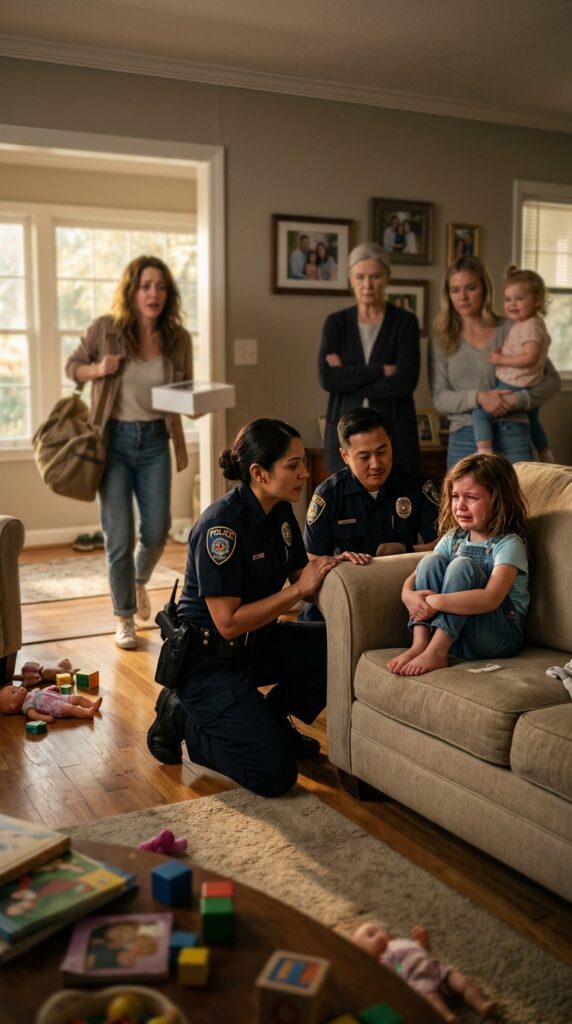
My Mother Called the Police on My Five-Year-Old Daughter. She Thought Fear Would Teach a Lesson. She Never Expected What Came Next.
The confirmation email landed in my inbox at 2:18 a.m.
Your recurring payment has been canceled.
One after another, every monthly transfer disappeared.
No angry message.
No dramatic announcement.
Just silence.
For the first time in years, I wasn’t paying to keep people happy.
I closed my laptop and walked to Charlotte’s bedroom.
She slept curled around her stuffed dragon, her tiny face finally peaceful.
I promised myself something right then.
No one—not even family—would ever make her afraid to come home again.
The next morning, I made chocolate-chip pancakes.
Charlotte barely smiled, but she helped stir the batter.
Children don’t always talk about fear.
Sometimes they simply become quieter.
That hurt even more.
Halfway through breakfast my phone rang.
Mom.
I let it ring.
Then Kendra called.
Ignored.
A text arrived seconds later.
“Your bank made a mistake. My car payment didn’t go through.”
Another followed.
“Mom’s electric bill is overdue. Fix whatever happened.”
I placed the phone face down and asked Charlotte if she wanted extra syrup.
She nodded.
That answer mattered more.
By lunchtime, there were twelve missed calls.
At three o’clock, my front doorbell rang.
I opened the door to find Mom standing there with Kendra behind her.
Neither looked concerned.
They looked inconvenienced.
“You canceled everything,” Mom said without greeting me.
“I did.”
“There has to be some misunderstanding.”
“There isn’t.”
Kendra folded her arms.
“You’re seriously punishing us over one little incident?”
I stared at her.
“One little incident?”
“You know what I mean.”
“No,” I replied calmly. “Charlotte spent an hour believing strangers were taking her away because you wanted to scare her.”
Mom sighed dramatically.
“You always exaggerate.”
I almost laughed.
Not because it was funny.
Because hearing those words again made something inside me finally click.
That sentence had followed my entire childhood.
You’re exaggerating.
You’re too sensitive.
You’re making a scene.
It had never been true.
It had simply been easier than apologizing.
“I won’t argue,” I said.
“I just want my granddaughter.”
“You had her.”
Mom blinked.
“You chose to use fear instead of love.”
For the first time in my life, I shut the door while my mother was still talking.
My hands shook afterward.
Setting boundaries isn’t dramatic.
It’s exhausting.
The following week became chaos.
Kendra couldn’t make her loan payment.
Mom complained to relatives that I had abandoned family.
Suddenly I was getting calls from cousins I hadn’t heard from in years.
“Your mother’s struggling.”
“You know how she is.”
“Can’t you just let it go?”
I answered every conversation the same way.
“Did anyone ask how Charlotte is doing?”
Silence.
Every time.
Charlotte started seeing a child therapist.
After the third visit, the therapist asked to speak with me privately.
“Your daughter keeps asking whether grown-ups can have the police take children away if they don’t like them.”
The words hit me like ice water.
I hadn’t realized how deeply the fear had settled.
“No,” I whispered.
“They can’t.”
“She believes she has to be perfect so adults won’t call the police again.”
I drove home crying harder than I had the day I found her.
Not because she was broken.
Because someone she trusted had taught her that love could disappear the moment she made a mistake.
That lesson would take time to undo.
But we would undo it.
Together.
Months passed.
Slowly, Charlotte laughed again.
She invited friends over.
She stopped asking if she was “good enough.”
Every small smile felt like a victory.
Meanwhile, my finances changed in ways I hadn’t expected.
Without supporting three different households, I finally had savings.
Real savings.
I replaced the old roof.
Started Charlotte’s college fund.
Booked our first real vacation.
The money I’d been using to rescue adults was now building a future for my child.
That felt right.
Six months after everything happened, Mom sent a letter.
Not a text.
Not a voicemail.
A handwritten letter.
She admitted she had crossed a line.
She said she had believed strict discipline built strong children because that was how she’d been raised.
She wrote that watching me walk away had forced her to see something she had ignored for decades.
Fear creates obedience.
It doesn’t create trust.
At the bottom she had written one sentence.
“If Charlotte ever wants to see me again, I will spend however long it takes earning that privilege.”
Not demanding it.
Earning it.
That was new.
I didn’t answer immediately.
Forgiveness isn’t measured by calendars.
It’s measured by change.
For nearly a year we met only in public places.
Short visits.
Parks.
Ice cream shops.
Always with me present.
Mom never raised her voice.
Never criticized.
Never threatened.
When Charlotte spilled juice one afternoon, Mom instinctively opened her mouth.
Then she stopped.
She grabbed paper towels instead.
“I’m sorry,” she told Charlotte softly.
“It’s only juice.”
Charlotte looked surprised.
Then she smiled.
A tiny smile.
But a real one.
One evening, after Grandma had gone home, Charlotte climbed into my lap.
“I think Grandma is trying really hard.”
“I think she is too.”
“People can learn?”
“They can.”
“What if they don’t?”
I kissed the top of her head.
“Then we love them from far away.”
She thought about that for a moment before wrapping her little arms around me.
“I’m glad you came home early that day.”
“So am I.”
Because sometimes life changes in one ordinary moment.
One canceled meeting.
One unexpected drive home.
One front door opening.
If I had come back one day later, I might never have known what happened.
Instead, I saw the truth.
And once you see the truth, you can’t pretend it isn’t there.
People often think the strongest thing a parent can do is fight.
Sometimes it is.
But sometimes the strongest thing is much quieter.
It’s closing a laptop after canceling the last payment.
It’s locking your front door.
It’s choosing your child’s peace over someone else’s approval.
My mother thought calling the police would teach my daughter a lesson.
She was right.
It did.
But not the one she intended.
Charlotte learned that fear has no place in love.
And I learned that protecting my daughter sometimes meant walking away from the people who should have protected both of us in the first place.