The first time my six-year-old son met my sister-in-law in person, he did not say hello.
He did not hide behind my coat or ask for the toy car he had been carrying around the department store for twenty minutes.
He pointed straight at her in the toy aisle, went pale beneath the fluorescent lights, and said, “She’s hiding my brother.”
For one second, I thought I had misheard him.
The store was loud in that December way, all plastic bells, squeaking carts, holiday music, and parents trying to get through errands before someone cried.
The seasonal aisle smelled like cinnamon candles, fake pine, and burnt coffee from the stand near the entrance.
Noah had been begging to help me choose Christmas lights for the front porch.
He wanted blue ones because Eli had once called blue lights “the cold stars.”
Eli had been missing for almost a year.
He was four years old when he vanished from a church fall festival on a chilly October evening.
One minute he was beside me at a folding table, painting a pumpkin with too much orange paint and telling me he was making it “extra Halloween.”
The next minute, he was gone.
Not hiding under a table.
Not wandering near the bounce house.
Gone.
The first police report listed the time as 6:42 p.m.
The detective wrote “active abduction investigation” on the first page of the case summary, and I remember staring at those words because they looked too official for something that had just torn my life open.
Search dogs came before midnight.
Volunteers walked through nearby woods and drainage ditches with flashlights.
People taped Eli’s picture to gas station doors, grocery store windows, school bulletin boards, and the church hallway where I had last heard him laugh.
For weeks, our house smelled like wet boots, old coffee, printer ink, and fear.
Then the searches got smaller.
The phone calls slowed.
The detective still checked in, but his voice changed from urgent to careful.
People stopped asking what they could do and started looking at me with that soft, terrible face people use when they think hope has become embarrassing.
Caleb, my husband, took it hard.
At least I thought he did.
He slept on the hallway floor outside Noah’s room for three weeks because he said he could not stand being that far from our last child.
He printed flyers until our home printer jammed and burned through two cartridges of black ink.
He stood beside me at press updates with his arm locked around my waist so tightly I sometimes had bruises from his fingers.
Back then, I thought that was grief.
Later, I would understand that guilt can imitate grief almost perfectly if the person wearing it knows where to place their hands.
Noah was different after Eli disappeared.
He had always been different, honestly, though I hated admitting that because people either made it mystical or made it medical, and I did not want my child turned into anybody’s theory.
Since he was three, Noah had known things he should not know.
He once asked why the mailman’s hand hurt two days before the man showed up wearing a cast.
He told a cashier her dog was “waiting by the lake,” and the woman burst into tears because her dog had died that morning at a veterinary clinic near a lake.
Once, in the school pickup line, he told me not to drive behind the green truck.
Three minutes later, a ladder slid off that truck and hit the pavement exactly where we would have been.
I called it intuition when people asked.
Children notice things, I told myself.
Some children notice more.
But that day in the toy aisle was not intuition.
That day felt like someone had opened a locked door inside my son and let the truth walk out.
Rachel, Caleb’s older sister, had returned to Ohio a month earlier after years of what the family called “traveling.”
With Rachel, traveling could mean a yoga retreat, a bad boyfriend, unpaid rent, or disappearing when people started asking her for money back.
I had only met her once on a video call.
Noah had never seen her in person.
She came up behind us with a paper coffee cup in one hand and an empty shopping basket in the other.
“There’s my favorite nephew,” she said.
Her smile was bright.
Too bright.
Noah turned.
His face changed so quickly I dropped the string of lights I was holding.
He backed into my leg and pressed both hands into my coat.
Then he pointed at Rachel.
“She’s hiding my brother.”
Rachel froze.
I gave a nervous little laugh because that is what adults do when fear shows up in a public place.
“Noah,” I said softly, “what are you talking about?”
He did not look at me.
He stared at Rachel as if he could see through her skin.
“She knows where he is,” he said.
Rachel’s fingers tightened around her coffee cup.
The plastic lid bent inward.
“He cries in the dark when the loud door closes,” Noah whispered.
The aisle seemed to lose sound.
A woman holding a roll of wrapping paper stopped moving.
A teenage employee in a red vest looked up from his scanner.
Rachel laughed once.
It was a small, dry sound.
“Okay,” she said. “Kids are creepy.”
Her mouth was smiling, but her eyes were not.
That was the first thing my body understood before my mind did.
People tell on themselves in the first second.
After that, they perform.
Rachel crouched in front of Noah.
“Sweetie,” she said, “that’s not a nice joke.”
Noah’s voice was barely a whisper.
“I’m not joking.”
I took his hand.
“We’re leaving.”
Rachel stood so fast her basket hit her thigh.
“Don’t be insane, Mara.”
Insane.
That word landed in the softest, most bruised part of me.
Every mother of a missing child lives with a private fear that grief has made her unreliable.
Every strange thought, every dream, every sudden turn of the head in a parking lot feels like evidence that maybe you have lost your grip.
Rachel knew that.
Then she made it worse.
“You are seriously going to turn a child’s weird imagination into an accusation?” she said.
I looked at her.
“Did Caleb know you were coming here?”
“No, but that’s not—”
“Stay away from my son.”
Her face hardened.
“He always did get the stories mixed up after the other one disappeared.”
The other one.
Not Eli.
Not your son.
Not my nephew.
The other one.
Something inside me went still.
Not calm.
Not peaceful.
Still in the way an animal goes still right before it runs or bites.
I got Noah to the SUV.
I buckled him in with hands that did not feel like mine.
The Christmas lights stayed in the cart near the curb.
When I shut the driver’s door, the outside noise softened, and all I could hear was Noah breathing too fast in the back seat.
I looked at him in the mirror.
“Why did you say Aunt Rachel is hiding Eli?”
He stared out the windshield.
For a long time, he said nothing.
Then he pressed both palms to his chest.
“Because he was calling from behind her.”
“Calling how?”
“Not with talking,” Noah said.
His eyes filled.
“With scared.”
A reasonable person would have called the detective first.
A careful person would have driven home and waited for Caleb.
I did neither.
I was not reasonable.
I was not careful.
I was a mother who had spent ten months being told to wait.
At 2:18 p.m., I drove to Rachel’s rental house on the edge of town.
Caleb had told me she was staying there temporarily while she “figured herself out.”
The house was small, with a sagging mailbox near the road and a little American flag clipped to the porch rail.
The flag snapped in the cold wind like it belonged to a perfectly ordinary home.
The garage was detached, sitting behind the house at the end of a cracked driveway.
The garage door was shut.
The padlock on the side gate looked new.
Noah saw it and screamed.
Not yelled.
Screamed.
“He’s in there! Mom, he’s in there!”
The sound tore through the SUV.
I pulled over so hard the tires scraped the curb.
I called 911 before I opened the car door.
The dispatcher asked my location.
I gave it.
She asked if I was in immediate danger.
I looked at the garage.
“My missing son may be inside,” I said.
My voice did not sound like my own.
Police arrived in seven minutes.
I know because the call log later showed 2:21 p.m. for dispatch and 2:28 p.m. for arrival.
One officer told me to stay by the vehicle.
Another went to the side gate and examined the padlock.
Rachel was not home.
Noah was sobbing into his sleeves.
The officer cut the lock.
The sound was sharp and final.
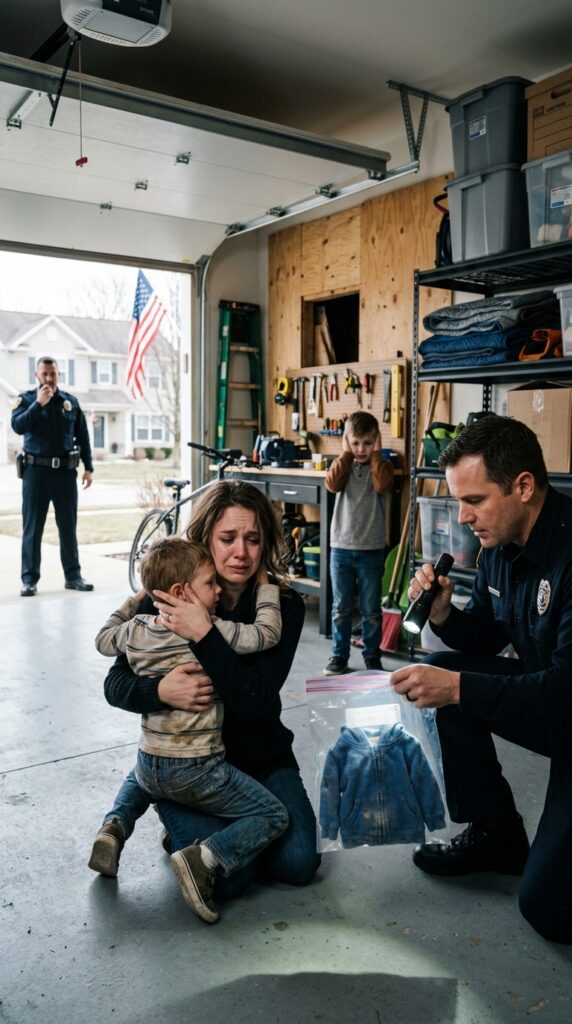
The garage smelled like motor oil, damp cardboard, dust, and something sour underneath.
There were storage bins stacked along one wall, a broken lawn chair, a red gas can, old paint cans, and a workbench covered with rags.
At first, I saw nothing.
Then Noah cried out, “Behind there.”
He pointed to the back wall.
One of the officers moved a stack of plastic bins.
Behind them was plywood.
Too clean.
Too new.
The officer knocked once.
The sound came back hollow.
The second officer called for tools from the patrol car.
I remember gripping the sleeve of my coat so hard my nails bent backward.
I remember thinking that if they opened that wall and found nothing, I would never survive the drive home with Noah.
Then the plywood came loose.
Behind it was a narrow storage space.
There was a cot inside.
There was a plastic water jug.
There was a little boy sitting against the wall, filthy and blinking into the flashlight beam.
For one second, I did not move.
My mind refused to put the image together.
Then he lifted his face.
Eli.
My Eli.
Alive.
I dropped to my knees so hard pain shot up both legs.
He made a sound that was not a word.
I crawled the last few feet and pulled him into my arms.
He was thinner than he should have been.
His hair was longer.
His hoodie smelled like dust, sweat, and old fear.
One sock was missing.
His hands clutched my coat with a strength that broke me.
I kept saying his name.
I do not know how many times.
The officers were talking into radios, calling for medical assistance, calling for detectives, calling for supervisors.
Then Eli buried his face in my neck and sobbed three words that changed everything again.
“Don’t let Daddy come in.”
The garage went silent except for the crackle of a police radio.
I felt the world tilt.
Caleb was Daddy.
Caleb was his father.
Caleb was the man who had held me while I screamed into towels so Noah would not hear.
One officer crouched lower.
“Eli,” he said gently, “who is Daddy?”
Eli shook so hard his teeth clicked.
“He said I had to be quiet,” Eli whispered.
My arms tightened around him.
The officer did not look at me.
He looked at his partner.
That look was the first official thing that told me my life was about to split open in a second place.
Then the second officer found the coat.
It was behind a red gas can, folded inside a clear plastic bag.
A blue winter coat.
Eli’s winter coat.
The one Caleb said must have been taken by whoever grabbed him at the festival.
The one police had searched for.
The one I had described in the missing child flyer.
Inside the collar, in black marker, was ELI M.
Noah saw it and slid down the garage wall with both hands over his ears.
He was crying without sound now.
The officer sealed the coat into an evidence bag and marked the time.
2:41 p.m.
That timestamp later appeared in the supplemental police report.
At the time, it only looked like a hand writing on plastic while my son shook in my lap.
Then headlights turned into the driveway.
Not Rachel’s car.
Caleb’s truck.
He parked too fast.
The driver’s door flew open before the engine died.
His work boots hit the gravel.
For one second, he looked annoyed.
Then he saw the police cars.
Then he saw the open garage.
Then he saw me on the floor holding Eli.
I watched his face change.
Confusion.
Fear.
Calculation.
The mask did not fall all the way off.
It only slipped.
But it slipped enough.
The lead officer stepped between us.
“Sir, keep your hands where I can see them.”
Caleb looked at Eli.
Then at me.
Then at the officer holding the evidence bag.
His mouth opened.
For a moment, no sound came out.
Then he whispered, “Rachel said she could fix it.”
That was the sentence.
Not “What happened?”
Not “You found him.”
Not my son’s name.
Rachel said she could fix it.
I remember the officer going very still.
I remember my own hand moving to cover Eli’s ear, even though it was too late to keep him from hearing.
Caleb tried to step forward.
The officer told him again to stop.
He did not.
The second officer moved quickly, turned him, and put his hands behind his back.
Caleb started talking then.
People like Caleb always talk when silence would save everyone else.
He said it was not what it looked like.
He said Rachel had panicked.
He said Eli had been safe.
He said he had only agreed for a few days.
He said I would never understand.
That was when Eli whimpered into my coat.
I looked down at my son and realized the man I had loved was standing ten feet away explaining the storage of a child like he was explaining a mistake on a receipt.
The ambulance arrived soon after.
The EMTs wrapped Eli in a blanket and checked his pulse, temperature, pupils, and blood pressure.
He would not let go of my hand.
Noah would not let go of my other hand.
I rode in the ambulance with both of my sons while officers stayed behind with Caleb and waited for detectives.
At the hospital intake desk, I had to give Eli’s full name and date of birth.
My voice broke on the year.
A nurse put a hospital wristband on his tiny wrist.
She moved carefully, like he was made of glass.
The emergency department smelled like antiseptic, coffee, and warmed blankets.
A doctor examined him.
A social worker came in.
A detective arrived with a notebook and a face that had lost all softness.
Eli was dehydrated and underweight.
He had no major physical injury, which the doctor said gently, as if that was supposed to be mercy.
It was mercy.
It was also not enough.
Rachel was arrested later that evening when she returned to the house.
The police found prepaid phones in a kitchen drawer, a ledger with dates and cash amounts, and a handwritten schedule taped inside a cabinet door.
There were initials beside days of the week.
C for Caleb.
R for Rachel.
The detective later told me Rachel claimed Caleb brought Eli to her the night of the festival.
She said Caleb told her it was temporary.
She said he was afraid I would leave him after I found out about debts, gambling, and money he had taken from an account meant for the boys.
She said hiding Eli was supposed to “punish” me long enough to make me dependent on him again.
Then the story got worse.
Caleb had not planned for the police attention to become that large.
He had thought Eli would be “found” after a few days.
But when the case exploded, when search teams came and cameras showed up and flyers went everywhere, he panicked.
Rachel took Eli to Nevada for several months.
Then she brought him back when money ran low.
That was the “traveling.”
That was the return to Ohio.
That was the rental house.
All those months, Caleb had visited enough to keep Rachel quiet and Eli afraid.
He had stood beside me at vigils after leaving that garage.
He had held my hand while knowing exactly where our son was.
Some betrayals are not one act.
They are a calendar.
A thousand ordinary mornings with a monster drinking coffee at your kitchen table.
The investigation took months.
There were forensic interviews, phone records, financial records, store receipts, gas station footage, and the church festival timeline rebuilt minute by minute.
The county prosecutor filed charges against both of them.
I will not pretend I understood every legal phrase.
I understood enough.
Kidnapping.
Child endangerment.
Obstruction.
Conspiracy.
Words that sounded too clean for what they had done.
Rachel cried in court.
Caleb did not.
He looked smaller than I remembered, sitting there in a dress shirt he had worn to Eli’s preschool program two years earlier.
At one hearing, his attorney suggested that Caleb had been mentally unwell after financial stress and marital fear.
The judge listened without changing expression.
Then the prosecutor played part of Rachel’s recorded interview.
Rachel’s voice filled the courtroom, thin and shaking.
“He said if Mara had both boys, she’d leave him. He said she loved being a mother more than she loved being his wife.”
I felt Noah’s small hand tighten around mine.
Eli was not in the courtroom that day.
He did not need to hear any of it.
My mother sat on my other side, staring straight ahead with tears running down her face.
The judge ordered both Caleb and Rachel held through trial.
Eventually, Rachel accepted a plea agreement and testified.
Caleb fought longer.
Men like him often do.
They believe if they keep talking, the world will rearrange itself around their version.
But paperwork is patient.
Phone records are patient.
Children, when finally safe, can become patient too.
Eli’s forensic interview was the hardest document I have ever read.
It described things in careful, clinical language.
The loud door.
The cot.
The days Rachel was kind.
The days Rachel was not.
The times Daddy came and told him Mommy was sick, Mommy was angry, Mommy could not come yet.
That was the part that nearly ended me.
He had not only stolen Eli from me.
He had stolen me from Eli.
For months after Eli came home, he slept with the lights on.
Noah slept on a mattress beside his bed.
I slept in the doorway more nights than I can count.
The first time Eli asked for cereal by himself, I cried into the sink so he would not see.
The first time he laughed, really laughed, Noah looked at me like he had been holding his breath for a year.
Recovery was not pretty.
It was appointments, nightmares, school paperwork, therapy rooms, police follow-ups, and learning which sounds made Eli flinch.
A garage door.
A padlock.
A man’s boots on gravel.
Noah stopped talking about what he sensed for a while.
I never pushed him.
One evening, months later, he sat with Eli on the living room rug building a crooked tower of blocks.
Eli knocked it over and laughed.
Noah looked at me.
“He’s not calling scared anymore,” he said.
I had to leave the room.
Caleb was convicted.
Rachel was sentenced too.
I will not say the numbers fixed anything.
Years in prison do not give a child back his missing months.
They do not erase the smell of that garage or the sound Eli made when he saw me.
But they did something.
They put a locked door between my sons and the people who had turned love into a weapon.
The house changed again after that.
Not all at once.
The boys’ sneakers returned to the back door, both pairs this time.
Two cereal bowls sat in the sink.
Two backpacks leaned against the hallway wall.
The blue porch lights went up the next Christmas because Eli asked for them.
He called them tiny stars again.
I stood in the driveway and watched both my sons look up at them while their breath fogged in the cold.
For a long time, I had learned how to breathe around an absence.
Now I was learning something stranger.
How to breathe around a miracle that still hurt.
People ask me whether I believe Noah has a gift.
I do not know what word to use.
I only know that my six-year-old son saw a woman in a toy aisle, heard something the rest of us could not hear, and refused to let the world call it imagination.
He said, “She’s hiding my brother.”
And because he said it, I drove to a garage.
Because I drove to that garage, a locked wall came down.
Because that wall came down, Eli came home.
That is not a story about magic to me.
It is a story about listening when a child is brave enough to tell the truth before adults are ready to believe it.